
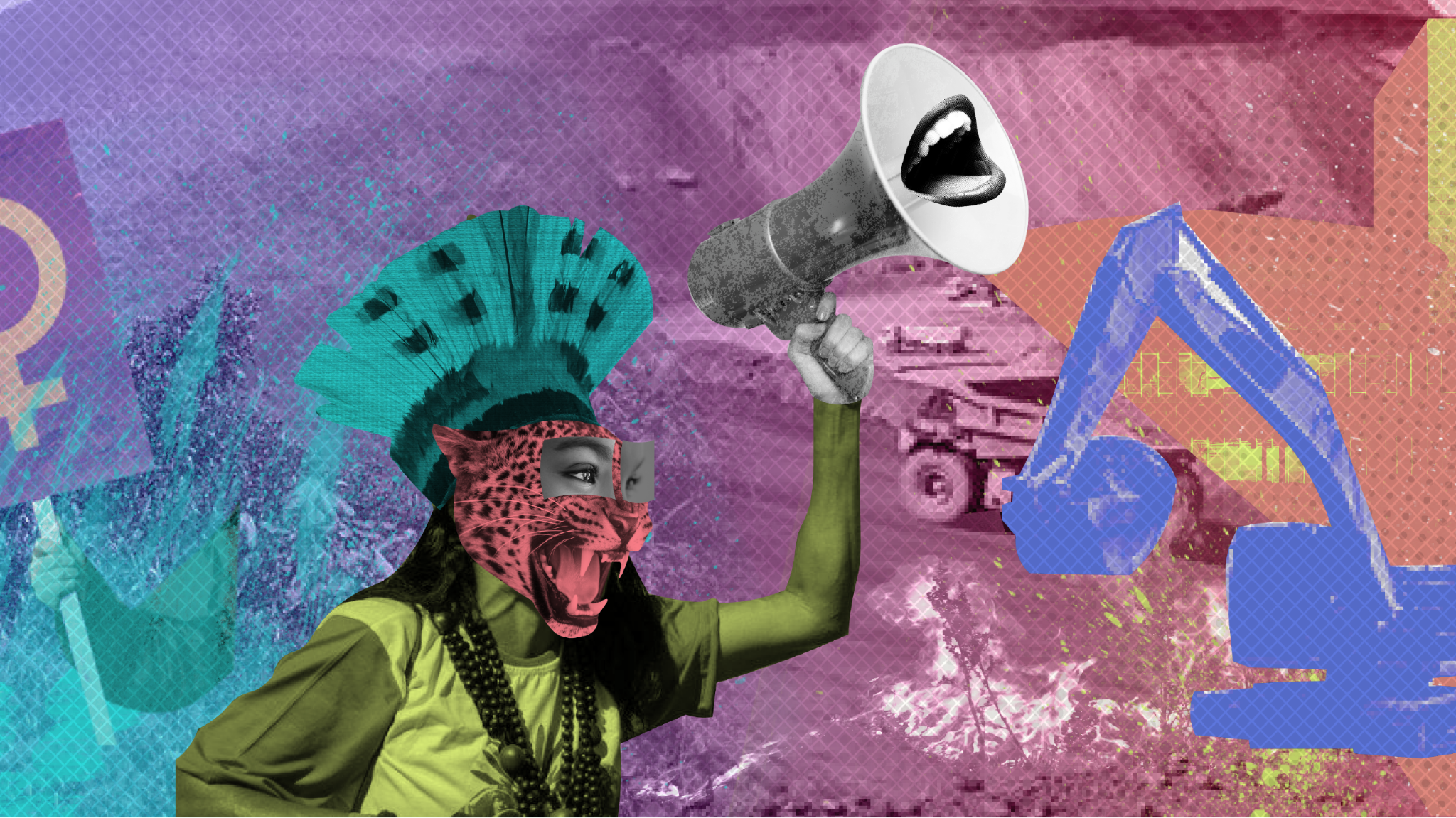
Across the Amazon, an exodus is unfolding. Indigenous women are being pushed from their ancestral lands by a surge of environmental crime and climate-driven collapse. As illegal mining, logging and land-grabbing intensifies, entire communities are being forced to leave their territories. But increasingly, it’s Indigenous women leaders who are the most affected and driven away by violence and threats.
Early last year, seven Kumaruara families from the Muruari village in the Brazilian Amazon were forced to leave their land because of climate change and environmental crimes. Before they moved, they lived along the Tapajós River in the state of Pará, where fires caused by the environmental crisis had dried up local streams.
Soon after the village began to recover from the Covid-19 pandemic, a logging company threatened to open a road through their territory, a move that they believe would have facilitated illegal drug trafficking. The Kumaruara were never consulted about the construction. “We, women, came together to stop this advance, and we managed to resist,” says Indigenous leader Luana Kumarawara, who is from Muruari.
During Jair Bolsonaro’s government, environmental crimes such as illegal mining in the Amazon intensified, with the dismantling of several forest protection policies. The Muruari territory was visited by the Inter-American Commission on Human Rights (CID). At the event early last year, supporters of former president Bolsonaro intimidated the Indigenous people.
“I filmed it, then one of them hit me and broke my cell phone, then I was threatened by email,” says Kumarawara. Feeling unassisted by the state and afraid, she left her two children with her family in the territory and was forced to migrate to the capital, Belém. “I left because of the violence and for the safety of my children,” she says.
Impact of environmental displacement
Kumarawara’s reality is that of many Indigenous women across the Amazon. They migrate to avoid situations of violence due to invasions, illegal mining, drug trafficking, fishing, predatory hunting, and conflicts with logging companies. Environmental crimes, varying across territories, worsen climate change and create a scarcity of natural resources, also impacting the local economy.
“There is a lack of honey, herbs, and materials for the production of our medicines,” says Kumarawara.
Brazil ranks first in the Americas in internal displacement. In 2022, 708,000 people were forced to move within the country due to natural disasters, and 5,600 because of conflict and violence due to land disputes, according to figures from the Internal Displacement Monitoring Center (IDMC).
There is no official quantitative data from the Brazilian government on internal migration, according to the International Organization for Migration (IOM). The Digital Atlas of Disasters of Brazil uses the term “homeless” to describe people displaced by climate change and environmental crimes. The country’s northern region, home to 44.48% of Brazil’s Indigenous population, is the most affected. Pará and Amazonas have the highest number of victims. In Pará alone, between 2012 and 2022, there were 582 climate disasters, leaving 460,000 people homeless in the last 10 years of the research (2012–2022).
Fire and invasion on the riverbanks
Also along the Tapajós River, in the state of Pará, lies the Munduruku Indigenous land. It is the second worst-affected territory by illegal mining in Brazil, behind only the Yanomami territory, which is facing a serious humanitarian crisis caused by this criminal activity.
Maria Leusa Munduruku, the first female leader of the Munduruku peoples in the municipality of Jacareacanga, has been fighting against mining and hydroelectric plants on the Tapajós River since 2013. She and other women stand at the frontline of resistance of the Munduruku peoples, and are often targeted and threatened by miners who attempt to silence them.
Under the previous Brazilian government, which oversaw a 90% increase in mining, the invasion of territories became more common and the fight for the demarcation of her village weakened. As a result, Leusa Munduruku was the victim of several threats to her life. In 2021, miners vandalized, looted and burned the Munduruku Women’s Association, which she coordinated.
On another occasion, miners stole transport and fuel from the Women’s Association and attacked their village. As the invasion of their land progressed, the Mundurukus created a group of warriors. “It was our only strategy because the government wasn’t going to do anything. They burned my house down,” said Leusa Munduruku.
Overcoming challenges of displacement
After not being able to obtain protection from national security forces, Leusa Munduruku and her family were eventually forced to leave the territory – just like Luana Kumaruara. She also stepped down from the Women’s Association. She moved to Santarém, still in the Amazon region, to study law at the federal university, hoping to return and defend her people’s rights through the justice system.
“I follow the fight from afar, but I’m still part of it, especially because the invasions for illegal mining continue in the same way,” she says.
Edina Shinenawa, an Indigenous activist and chief of the Shanetatxakaya women’s village in Acre, another region in the western Amazon, shares that: “when they touch our land, they also touch our human body. We in the forest are already feeling these changes.”
Acre has seen an increase in floods in March last year that affected 93 Indigenous communities, destroying crops that would have sustained them throughout the year. According to the state government, this is the region’s worst environmental disaster: 10,700 people have been left homeless by river flooding, which now affects 86% of municipalities.
Shinenawa was displaced after heavy rains caused a landslide that destroyed local fields. Even before the disaster, she had already faced threats and various forms of violence from illegal miners who invaded the region and destroyed medicinal plants.
“We created another village and broke the tradition of passing the headdress only from father to sons,” she says. It was during this process that Shinenawa became the first woman chief of her people, a role in which she already feels the impact of climate change on the territory. “We need agro-ecological training to guarantee food security amid the environmental crisis,” she says.
In the Colombian Amazon
The challenge of displacement caused by environmental crimes also affects Indigenous women in the Colombian Amazon. Illegal armed groups are present in 33 of the 35 municipalities within the protected forest areas, according to the Institute of Studies for Development and Peace of Colombia (Indepaz).
The Revolutionary Armed Forces of Colombia (FARC), the National Liberation Army (ELN), and the Gulf Clan, among others, threaten Indigenous women, invade the territory for intensive livestock farming and mining, and assassinate leaders.
Hillary Jency Vanegas Melendez is an Indigenous trans journalist with a physical disability, from the Caquetá region, in the Colombian Amazon. She has faced violence both because of her identity and for defending her territory. She was attacked by FARC members and forced to migrate in 2013.
After she managed to escape the faction, her father was captured for 15 days in retaliation. “I didn’t eat. It was a very difficult time until they released my father,” she recalls. Vanegas Melendez can no longer return to her territory.
She says that every day she heard gunfire and bombs falling into the rivers. The Colombian government did not investigate the case. Kidnappings, recruitment of minors, and the murder of Indigenous women by militias continue. She notes that the invasions are worsening the effects of climate change in the territory. “Mercury is destroying nature, our rivers and fish are dying and people are getting sick,” she says.
Beyond the Amazon
Indigenous women face forced displacement not only in the Amazon but across biomes in Brazil. “I suffer violence and threats every day from mining and agribusiness companies, as do several leaders of the Guarani Kaiowá, Maxakali and Pataxó peoples,” says Shirley Krenak, an Indigenous leader from the Rio Doce Valley in Minas Gerais, in southeastern Brazil .
In the southern state of Rio Grande do Sul, floods in 2024 affected more than 16,000 Indigenous people, forcing many to migrate, according to the SESAI Report by the Ministry of Indigenous Peoples. “Several Indigenous families end up in the city favelas, where they suffer most from climate change disasters,” says Avelin Buniacá, an Indigenous leader and sociologist from the Kambiwá people.
She highlights the lack of climate adaptation and prevention policies in Brazil. “There are no harm-reduction projects for Indigenous people inside or outside their territories,” she says.
Jizelma Xukuru from Bahia, an Indigenous woman from Xukuru’s people, has lived for two years on a farm owned by the mining company Vale in Brumadinho, Minas Gerais. She fled with her family after receiving threats from farmers in the northeast. Vale considers their presence an “irregular occupation” and has repeatedly blocked road access.
“They wouldn’t let us pass,” says Xukuru. When a child with asthma suffered a respiratory crisis, Vale security guards stopped the community from reaching the hospital. “The boy turned blue, and they still didn’t let us through. We armed ourselves with bows and arrows, painted our bodies, and went there to fight. Only then did they retreat.” Xukurus Indigenous people still fight to have a place of their own and are monitored with Vale company drones.
The Xukuru contacted the National Foundation of Indigenous Peoples (Funai) to secure a territory, but they have received no response. The case is before the Public Prosecutor’s Office. “Funai used to be more present. Now, I feel like it is turning its back. Where are we going to live if we leave here?” Xukuru asks.
The body as a site of resistance
The greatest violence against Indigenous peoples is the destruction of their territories. “If they destroy our land, they are killing us,” says Graça Tapajós, an Indigenous leader from the Cobra Grande territory, in Pará, Amazon.
A member of the Indigenous Consciousness Group (GCI), she was persecuted by miners. “They were looking for me to kill me, so I had to leave my territory,” she says. But exile, she insists, does not sever her connection to home. “I may live in the city now, but part of me is still in my territory, and that makes us fight even harder.”
For Maura Arapiuns, another Indigenous leader from the same region of Tapajós who was also forced to leave her village, her body is also her territory. “Even when I leave, or am expelled, my ancestry will always go with me,” says Arapiuns. She believes that fighting for the preservation of land also means ensuring the preservation of their bodies.
Not all Indigenous women can migrate and some end up being sexually exploited, suffering from rape and poverty in the territories. “We are the most impacted since the arrival of colonization. We need to be at the forefront and have representation in the fight,” argues leader Rosimary Arapaço, from the Indigenous land of Alto Rio Negro, in the state of Amazonas, who coordinates the Makira-Êta Women’s Network and the Union of Indigenous Women of the Brazilian Amazon (UMIAB). She thinks it’s important that women participate politically in the Indigenous movement.
Institutional silence
Arapaço believes that both federal and state governments fail to protect the Amazon forest and Indigenous women. “They resist demarcating our territories. Profit always comes before Indigenous life and riverside people,” she says. “We need to try to reduce the impacts of these extreme events and crimes, and not just try to react afterward.”
The Brazilian government is developing a climate plan. The expectation is that the plan will take into account the realities of Indigenous peoples across the country. A proposal is also urgently being processed with the National Policy for Environmental and Climate Displaced Persons (PNDAC) in the Chamber of Deputies, Brazil’s lawmaking body. It will establish measures to guarantee health, housing, employment and education for those most affected by displacement.
Yet all the Brazilian Indigenous women interviewed in this report say that Funai, the agency responsible for monitoring territories and supporting Indigenous peoples, has remained silent. None received institutional protection when threatened or displaced. Funai did not respond to requests for comment before this story was published.
This report was supported by the Earth Journalism Network